


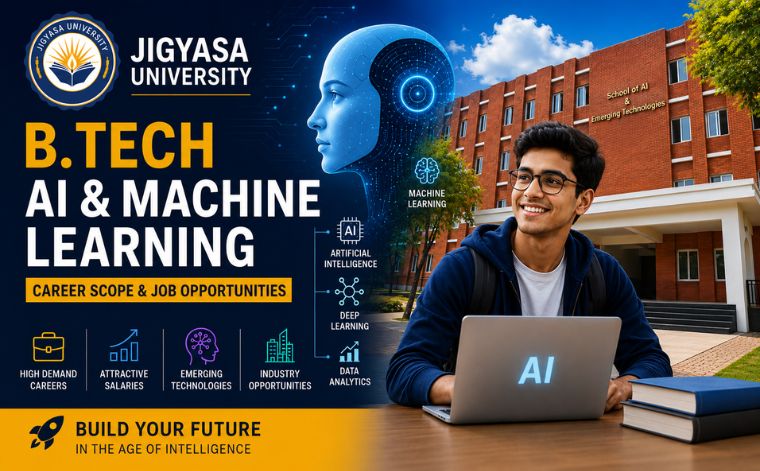
B.Tech AI & Machine Learning: Career Scope & Job Opportunities
Artificial Intelligence (AI) and Machine Learning (ML) are changing the way businesses work, make decisions, and serve customers. From recommendation systems and chatbots to autonomous vehicles and fraud detection, AI is now being used across many industries.
This growth has created strong demand for professionals who can develop, train, test, and deploy intelligent systems. The World Economic Forum's Future of Jobs Report 2025 identifies AI and Machine Learning Specialists among the fastest-growing job roles through 2030. It also lists AI and big data among the fastest-growing skill areas.
For students interested in technology, mathematics, programming, and problem-solving, a B.Tech in AI & Machine Learning can provide a strong foundation for a technology-focused career.
But what exactly can you do after this degree? Which jobs are available? What skills do companies expect? And what is the future scope of AI and Machine Learning?
Let's explore everything in detail.
What is B.Tech AI & Machine Learning?
B.Tech AI & Machine Learning is a four-year undergraduate engineering programme that focuses on Artificial Intelligence, Machine Learning, data analysis, programming, and intelligent computing systems.
The course generally combines computer science fundamentals with specialized AI and ML subjects.
Common Subjects in B.Tech AI & ML
Depending on the university, students may study subjects such as:
- Programming in Python, C++ or Java
- Data Structures and Algorithms
- Database Management Systems
- Computer Networks
- Operating Systems
- Mathematics for Computing
- Probability and Statistics
- Artificial Intelligence
- Machine Learning
- Deep Learning
- Natural Language Processing
- Computer Vision
- Big Data Analytics
- Cloud Computing
- Generative AI
- MLOps
- Data Science
What Do Students Learn?
The main goal is to teach students how to use data and algorithms to develop systems that can identify patterns, make predictions, automate tasks, and support decision-making.
For example, a student may develop a machine learning model that predicts house prices based on historical data or build an AI application that identifies objects in images.
Why Choose B.Tech AI & Machine Learning?
Growing Demand for AI Professionals
AI is no longer limited to research laboratories or large technology companies. Businesses in finance, healthcare, retail, manufacturing, education, automotive, telecommunications, and other sectors are adopting AI-based solutions.
The World Economic Forum reports that AI and Machine Learning Specialists are among the fastest-growing roles globally for 2025–2030.
This creates opportunities for students who develop strong technical skills along with practical experience.
Wide Range of Career Opportunities
One major advantage of AI and ML is that the field includes several career paths.
A graduate can work as an:
- AI Engineer
- Machine Learning Engineer
- Data Scientist
- AI Developer
- Deep Learning Engineer
- NLP Engineer
- Computer Vision Engineer
- MLOps Engineer
- Robotics Engineer
- AI Researcher
Therefore, students are not restricted to a single job profile.
Scope Across Industries
AI skills can be applied to different business problems.
For example:
Healthcare: Disease prediction, medical image analysis and patient monitoring
Banking: Fraud detection, credit risk analysis and automated customer service
Retail: Product recommendations, demand forecasting and customer analytics
Automobile: Autonomous driving, driver assistance and predictive maintenance
Education: Personalized learning and AI-powered assessment
Manufacturing: Quality inspection, robotics and predictive maintenance
This cross-industry application gives AI and ML graduates considerable career flexibility.
Opportunities for Innovation
AI is also a good field for students who want to build products or start their own businesses.
A student with the right technical and entrepreneurial skills can develop AI-powered applications, automation tools, recommendation engines, chatbots, analytics platforms, or industry-specific solutions.
B.Tech AI & Machine Learning Career Scope
The career scope after B.Tech AI & ML is expanding as organizations increasingly use data and intelligent systems to improve efficiency and decision-making.
According to the World Economic Forum, technology-related roles such as AI and Machine Learning Specialists, Big Data Specialists, and Software Developers are among the fastest-growing jobs expected through 2030.
The field is also evolving quickly. Traditional machine learning is now being combined with deep learning, generative AI, large language models, computer vision, cloud platforms, and automation.
This means students should focus not only on obtaining a degree but also on continuously developing practical skills.
Top Job Opportunities After B.Tech AI & ML
1. AI Engineer
An AI Engineer develops applications that use artificial intelligence to solve real-world problems.
Key Responsibilities
- Developing AI-based applications
- Working with machine learning models
- Processing and analysing data
- Integrating AI APIs and models
- Testing and improving AI systems
AI Engineers can work in technology companies, startups, financial services, healthcare, retail, manufacturing, and other sectors.
2. Machine Learning Engineer
Machine Learning Engineers design and implement systems that learn from data.
Key Skills
- Python
- Machine learning algorithms
- Data structures
- Statistics
- Model evaluation
- TensorFlow or PyTorch
- SQL
- Cloud platforms
For example, a Machine Learning Engineer may develop a recommendation system that predicts which products a customer is most likely to purchase.
3. Data Scientist
Data Scientists use statistics, programming, and machine learning to extract useful insights from data.
Typical Work Includes
- Collecting and cleaning data
- Analysing large datasets
- Creating predictive models
- Building dashboards and reports
- Communicating business insights
A strong understanding of statistics and data analysis is particularly valuable for this career.
4. AI Developer
AI Developers build software applications that use AI technologies.
They may work on:
- AI chatbots
- Recommendation systems
- Search systems
- Intelligent automation
- Generative AI applications
- Voice-based applications
This role is particularly suitable for students who enjoy software development as well as AI.
5. Deep Learning Engineer
Deep Learning Engineers work with neural networks and large datasets.
They may develop applications involving:
- Image recognition
- Speech recognition
- Natural language processing
- Recommendation systems
- Generative AI
- Pattern recognition
Knowledge of frameworks such as PyTorch and TensorFlow can be useful in this career.
6. NLP Engineer
Natural Language Processing (NLP) focuses on enabling computers to understand and process human language.
Examples of NLP Applications
- Chatbots
- Voice assistants
- Text classification
- Sentiment analysis
- Translation systems
- Document analysis
- Search engines
With the growth of generative AI and large language models, NLP-related knowledge has become increasingly relevant.
7. Computer Vision Engineer
Computer Vision Engineers develop systems that allow computers to interpret images and videos.
Applications Include
- Face recognition
- Medical image analysis
- Object detection
- Security systems
- Autonomous vehicles
- Industrial quality inspection
Students interested in image processing and AI can consider this specialization.
8. Robotics Engineer
Robotics combines AI, machine learning, electronics, control systems, and mechanical engineering.
AI can help robots understand their surroundings, make decisions, and perform tasks with greater autonomy.
Career opportunities can be found in:
- Industrial automation
- Manufacturing
- Autonomous systems
- Drones
- Healthcare robotics
- Research
9. MLOps Engineer
MLOps combines machine learning with software engineering and operations.
MLOps professionals help organizations deploy, monitor, update, and maintain machine learning models in production.
Important Skills
- Python
- Git
- Docker
- Kubernetes
- Cloud computing
- CI/CD
- Model deployment
- Monitoring
As companies move AI models from experimentation into real-world production, MLOps skills can become increasingly valuable.
10. AI Research Scientist
AI Research Scientists work on advanced algorithms, models, and AI techniques.
This career generally requires stronger mathematical and research skills. Many research-oriented positions also prefer or require postgraduate qualifications such as an M.Tech, MS, or PhD.
Students interested in research can focus on areas such as:
- Deep learning
- Generative AI
- Computer vision
- NLP
- Reinforcement learning
- AI safety
- Robotics
Skills Required for AI & Machine Learning Careers
A B.Tech degree provides the academic foundation, but employers also look for practical skills.
1. Programming Skills
Python is particularly important because it is widely used for data science and machine learning.
Students should also understand:
- Data structures
- Algorithms
- Object-oriented programming
- APIs
- Version control
C++, Java, or other programming languages can also be useful depending on the role.
2. Mathematics and Statistics
AI and ML involve significant mathematical concepts.
Important areas include:
- Linear algebra
- Probability
- Statistics
- Calculus
- Optimization
A good mathematical foundation helps students understand how machine learning algorithms work rather than simply using pre-built libraries.
3. Machine Learning
Students should understand major machine learning concepts such as:
- Supervised learning
- Unsupervised learning
- Classification
- Regression
- Clustering
- Feature engineering
- Model evaluation
- Overfitting and underfitting
4. Deep Learning
Students interested in advanced AI should learn the fundamentals of neural networks and deep learning.
Important concepts include:
- Neural networks
- CNNs
- RNNs
- Transformers
- Model training
- Transfer learning
5. Data Handling
AI systems depend heavily on quality data.
Students should learn:
- SQL
- Data cleaning
- Data visualisation
- Exploratory data analysis
- Data preprocessing
6. Cloud and MLOps
Knowledge of cloud platforms and deployment can make a graduate more job-ready.
Students can explore:
- AWS
- Microsoft Azure
- Google Cloud
- Docker
- Kubernetes
- Git
- CI/CD
7. Communication and Problem-Solving
Technical knowledge alone is not enough.
AI professionals must understand business problems, explain technical concepts clearly, collaborate with teams, and evaluate whether an AI solution actually solves the intended problem.
The World Economic Forum also highlights analytical thinking, creative thinking, resilience, flexibility, and lifelong learning as important skills alongside technical capabilities.
Industries Hiring AI & ML Professionals
AI and ML professionals can find opportunities in several industries.
|
Industry |
Example AI/ML Applications |
|
Information Technology |
AI software, automation, chatbots |
|
Banking & Finance |
Fraud detection, risk analysis |
|
Healthcare |
Medical imaging, prediction systems |
|
Retail & E-commerce |
Recommendations, demand forecasting |
|
Automobile |
Autonomous systems, driver assistance |
|
Manufacturing |
Predictive maintenance, quality control |
|
Telecommunications |
Network optimisation |
|
Education |
Personalised learning |
|
Cybersecurity |
Threat detection |
|
Agriculture |
Crop monitoring and prediction |
|
Media |
Content recommendations |
|
Logistics |
Route optimisation and forecasting |
This broad application is one of the key reasons why AI and Machine Learning offers diverse career opportunities.
B.Tech AI & ML Salary in India
Salary after B.Tech AI & ML depends on several factors, including skills, location, company, job role, internship experience, academic background, and practical projects.
Instead of focusing only on the degree, students should focus on building skills that employers can evaluate.
Factors That Can Influence Salary
- Programming ability
- Machine learning knowledge
- Internship experience
- Project portfolio
- Problem-solving skills
- Communication
- Knowledge of cloud technologies
- Specialisation in areas such as NLP, computer vision or generative AI
- Company and location
For example, a graduate with strong Python, SQL, machine learning, cloud, and project experience may be better positioned for an AI/ML role than a graduate who has only studied theoretical concepts.
Important: Salary figures can vary substantially across employers and experience levels, so students should check current job listings and company-specific compensation data before making salary expectations.
Career Growth After B.Tech AI & Machine Learning
AI and ML careers can develop in several directions.
A possible progression could look like:
B.Tech Graduate → AI/ML Intern → Junior AI/ML Engineer → Machine Learning Engineer → Senior ML Engineer → AI Lead/Architect
Another path could be:
B.Tech Graduate → Data Analyst → Data Scientist → Senior Data Scientist → AI/ML Lead
Students interested in research can follow:
B.Tech → M.Tech/MS → Research Engineer/Scientist → Senior Researcher
Career growth depends heavily on continuous learning because AI technologies change rapidly.
Higher Studies After B.Tech AI & ML
Students who want deeper technical knowledge can pursue postgraduate education.
M.Tech in AI & Machine Learning
An M.Tech can provide advanced knowledge in AI, ML, data science, computer vision, NLP, and related fields.
M.Sc./MS in AI or Data Science
Students may also consider an MS or related postgraduate programme, particularly if they want to study abroad or move towards research-oriented careers.
MBA
An MBA can be useful for students who want to combine technology with business and move towards roles such as:
- Product Manager
- Technology Consultant
- AI Business Strategist
- Product Leader
PhD
Students interested in advanced research, academia, or specialised AI research roles can consider a PhD.
How to Prepare for an AI & ML Career
Getting a B.Tech degree is only the beginning. Students should start building practical experience during college.
Step 1: Learn Programming
Start with Python and develop a strong understanding of programming fundamentals.
Step 2: Build a Strong Mathematical Foundation
Learn statistics, probability, linear algebra, and basic calculus.
Step 3: Learn Machine Learning
Understand algorithms rather than simply memorising their names.
Step 4: Work on Real Projects
Build projects that demonstrate your ability to solve practical problems.
Step 5: Complete Internships
Internships can provide exposure to real-world software development and data problems.
Step 6: Create a Portfolio
Upload suitable projects and code to platforms such as GitHub and maintain a professional resume.
Step 7: Participate in Competitions
AI and data science competitions can help students practise their skills using real datasets.
Step 8: Keep Learning
AI is evolving quickly. Students should regularly learn new frameworks, tools, models, and deployment practices.
Projects That Can Improve Your Resume
A strong project portfolio can help demonstrate practical knowledge.
Beginner Projects
- House price prediction
- Student performance prediction
- Spam email detection
- Customer segmentation
- Movie recommendation system
Intermediate Projects
- Sentiment analysis system
- Fraud detection model
- Face recognition application
- Sales forecasting system
- Disease prediction model
Advanced Projects
- AI chatbot
- Retrieval-augmented generation application
- Computer vision detection system
- AI recommendation engine
- Real-time predictive analytics platform
- AI-powered document analysis system
What Makes a Good AI Project?
A good project should explain:
- What problem are you solving?
- What dataset did you use?
- Which technology did you select?
- How did you train and evaluate the model?
- What results did you achieve?
- How can the solution be deployed?
This approach shows employers that you understand the complete development process.
Future Scope of AI & Machine Learning
The future of AI and Machine Learning looks promising, but the field will also become more competitive.
The World Economic Forum expects AI and big data to remain the fastest-growing skill area through 2030 and identifies AI and Machine Learning Specialists among the fastest-growing occupations.
At the same time, the report estimates that around 39% of workers' existing skill sets could be transformed or become outdated between 2025 and 2030.
This means students should not think of AI education as something that ends with graduation.
Emerging Areas to Watch
Generative AI
Generative AI can create text, images, audio, video, and code. Students can explore large language models, AI agents, retrieval-augmented generation, and model integration.
Computer Vision
Computer vision will continue to support applications in healthcare, manufacturing, security, automotive technology, and robotics.
Edge AI
Edge AI enables AI processing closer to where data is generated, which can be useful for devices, cameras, vehicles, and industrial systems.
AI in Robotics
Combining AI with robotics can create more capable autonomous systems.
Responsible AI
As AI becomes more influential, organizations will increasingly need professionals who understand issues such as privacy, fairness, transparency, security, and responsible model development.
B.Tech AI & ML vs B.Tech CSE
Students often wonder whether they should choose B.Tech AI & ML or traditional B.Tech Computer Science and Engineering.
|
Factor |
B.Tech AI & ML |
B.Tech CSE |
|
Main Focus |
AI, ML, data and intelligent systems |
Broad computer science |
|
Programming |
Strong |
Strong |
|
AI/ML Depth |
Usually higher |
Depends on electives |
|
Core CS |
Covered, but curriculum varies |
Usually broader |
|
Career Options |
AI/ML, data, software roles |
Software, cloud, data, security and more |
|
Specialisation |
Earlier specialisation |
Broader foundation |
|
Best For |
Students specifically interested in AI/ML |
Students wanting broader computing options |
The better choice depends on your interests and the curriculum offered by the university.
A student interested specifically in AI, machine learning, data science, computer vision, and intelligent systems may prefer AI & ML.
A student who wants maximum flexibility across software engineering, cybersecurity, cloud computing, databases, and other computer science areas may prefer CSE.
Is B.Tech AI & Machine Learning a Good Career Choice?
Yes, B.Tech AI & Machine Learning can be a strong career choice for students who genuinely enjoy technology, programming, mathematics, data, and problem-solving.
However, students should not choose the course only because AI is currently popular.
The strongest career outcomes generally come from combining:
Degree + Technical Skills + Projects + Internships + Problem-Solving + Continuous Learning
AI is also not a field where learning stops after college. New tools and techniques appear regularly, so professionals must continue developing their skills.
The current employment outlook supports this approach. The World Economic Forum projects strong growth in AI and Machine Learning roles while also stressing the importance of continuous upskilling.
Why Choose Jigyasa University for B.Tech AI & Machine Learning?
Choosing the right university is an important step for students who want to build a successful career in Artificial Intelligence and Machine Learning. Jigyasa University offers students an environment focused on technical education, practical learning, innovation, and career development.
Industry-Oriented AI & Machine Learning Education
Jigyasa University's B.Tech programme in AI & Machine Learning is designed to help students develop a strong foundation in computer science along with specialised knowledge of AI and ML.
Students can build knowledge in areas such as:
-
Artificial Intelligence
-
Machine Learning
-
Data Science
-
Deep Learning
-
Python Programming
-
Data Structures and Algorithms
-
Computer Vision
-
Natural Language Processing
-
Cloud Computing
-
Generative AI
This combination can help students understand both the fundamentals and practical applications of modern AI technologies.
Practical Learning and Skill Development
AI and Machine Learning are practical fields, so classroom learning should be supported by hands-on experience. Students can strengthen their understanding through projects, practical assignments, technical activities, and problem-solving exercises.
Working on real-world projects can help students understand how AI and ML are applied to areas such as healthcare, finance, e-commerce, manufacturing, education, and automation.
Experienced Faculty and Academic Support
A strong academic environment can make it easier for students to understand complex technical subjects. Faculty guidance can help students develop their programming, analytical, mathematical, and problem-solving skills while working on academic and practical projects.
Focus on Innovation and Emerging Technologies
AI is evolving rapidly, with technologies such as Generative AI, large language models, computer vision, robotics, and intelligent automation becoming increasingly important.
Students who are exposed to emerging technologies during their degree can better understand the changing requirements of the technology industry.
Career and Placement Preparation
A successful AI/ML career requires more than academic knowledge. Students also need communication skills, interview preparation, technical knowledge, project experience, and an understanding of industry expectations.
Jigyasa University can provide students with opportunities to develop these career-oriented skills through academic activities, practical exposure, internships, and placement-focused initiatives.
A Strong Foundation for Future Careers
After completing B.Tech AI & Machine Learning, students can explore careers such as:
-
AI Engineer
-
Machine Learning Engineer
-
Data Scientist
-
AI Developer
-
Deep Learning Engineer
-
NLP Engineer
-
Computer Vision Engineer
-
MLOps Engineer
-
Robotics Engineer
-
Software Engineer
Students can also pursue higher education such as M.Tech, MS, MBA, or PhD depending on their career goals.
Why Jigyasa University Can Be a Good Choice
For students looking for a technology-focused engineering education, Jigyasa University can be considered for its combination of academic learning, practical exposure, skill development, and career-oriented education.
The university's focus on emerging technologies can help students prepare for a technology landscape where AI and Machine Learning skills are becoming increasingly important.
If you are planning to build a career in Artificial Intelligence, Machine Learning, Data Science, or related technology fields, exploring the B.Tech AI & Machine Learning programme at Jigyasa University can be a valuable step toward your career goals.
Conclusion
B.Tech AI & Machine Learning offers students an opportunity to build a career in one of the most rapidly developing areas of technology. From AI Engineering and Machine Learning to Data Science, NLP, Computer Vision, Robotics, and MLOps, graduates can explore a wide range of career paths.
The demand for AI-related skills is expected to remain strong. However, earning a B.Tech degree alone does not guarantee a job. Students should develop strong programming and mathematical foundations, build practical projects, complete internships, and stay updated with emerging technologies.
For students who are passionate about technology and willing to keep learning, B.Tech AI & Machine Learning can provide a strong foundation for a future-focused career.
Frequently Asked Questions (FAQs)
Q1. What is the career scope of B.Tech AI & Machine Learning?
Ans. B.Tech AI & Machine Learning offers career opportunities in AI engineering, machine learning, data science, deep learning, NLP, computer vision, robotics, MLOps, software development, and AI research.
Q2. Is B.Tech AI & ML good for the future?
Ans. Yes. AI and Machine Learning are expected to remain important technology areas. The World Economic Forum lists AI and Machine Learning Specialists among the fastest-growing jobs for 2025–2030.
Q3. What jobs can I get after B.Tech AI & ML?
Ans. Common job roles include AI Engineer, Machine Learning Engineer, Data Scientist, AI Developer, Deep Learning Engineer, NLP Engineer, Computer Vision Engineer, MLOps Engineer, and Robotics Engineer.
Q4. Is coding necessary for B.Tech AI & ML?
Ans. Yes. Programming is an important part of AI and ML. Python is particularly useful, while knowledge of data structures, algorithms, SQL, and software development can also improve career opportunities.
Q5. Which programming language is best for AI and Machine Learning?
Ans. Python is one of the most widely used programming languages for AI and Machine Learning because of its extensive libraries and frameworks.
Q6. Can I become a Data Scientist after B.Tech AI & ML?
Ans. Yes. B.Tech AI & ML can provide a suitable foundation for Data Science. Students should additionally develop skills in statistics, SQL, data analysis, visualisation, and machine learning.
Q7. What skills should I learn during B.Tech AI & ML?
Ans. Focus on Python, data structures and algorithms, SQL, statistics, machine learning, deep learning, data analysis, cloud computing, MLOps, communication, and problem-solving.
Q8. Can AI & ML graduates work in non-IT industries?
Ans. Yes. AI and ML are used in healthcare, finance, retail, manufacturing, automobiles, agriculture, education, logistics, telecommunications, and many other sectors.
Q9. Is higher education necessary after B.Tech AI & ML?
Ans. Not always. Students can enter the workforce after B.Tech if they have the required skills and experience. However, M.Tech, MS, or PhD programmes can be useful for advanced technical, research, or academic careers.