

Centre for Indian Knowledge Systems
Introduction
The Centre for Indian Knowledge Systems (IKS) at Jigyasa University is a multidisciplinary hub dedicated to the exploration and advancement of India’s rich scientific, technological, and cultural heritage. Established under the aegis of the School of Education, the Centre is led by the Dean, School of Education, who provides academic and administrative leadership.
The Centre envisions promoting interdisciplinary and transdisciplinary research across diverse domains of Indian Knowledge Systems. It aims to preserve, revitalize, and disseminate this knowledge to foster a deeper understanding and appreciation among scholars, researchers, and society at large. Furthermore, the Centre seeks to facilitate meaningful applications of IKS in contemporary contexts, contributing to both academic enrichment and societal development.
Our Vision
The Vision of the IKS centre is to completely decolonize Indian mind by generating interest and healthy critical reverence for the unbroken knowledge traditions of Bharata for the welfare of the world.
Our Mission
The mission of the Centre for IKS is to promote, facilitate, and benefit from IKS-related studies, research, content development, and outreach.
Objectives
1. Interdisciplinary Research: Encouraging studies across various fields such as arts, literature, agriculture, sciences, engineering, architecture, and economics.
2. Preservation & Dissemination: Ensuring that ancient Indian wisdom is documented and shared for further research and societal applications.
3. Integration into Education: Incorporating IKS into school and higher education curricula to provide students with a deeper understanding of India's intellectual heritage.
4. Policy Recommendations: Developing strategies to support and fund research projects related to IKS.
5. Cultural Awareness: Promoting India's indigenous knowledge, including tribal traditions, ethno-medicinal practices, and sustainable agricultural methods.
ESTABLISHMENT OF CENTRE FOR INDIAN KNOWLEDGE SYSTEMS
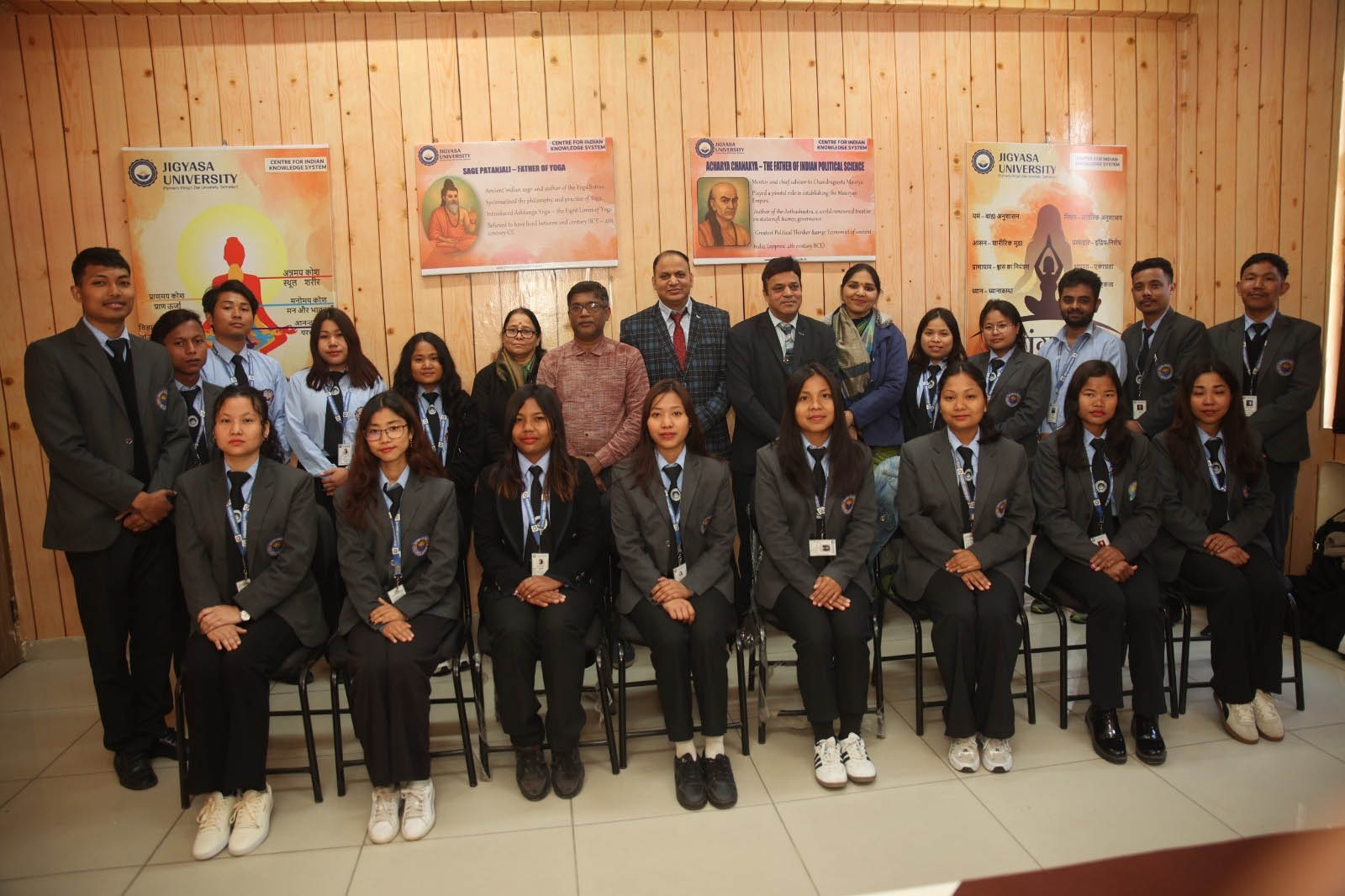
An IKS centre has established in the University to promote Indian Knowledge Systems among Staff and students of the University. The centre disseminates IKS knowledge at all levels of teaching-learning of the University. Since IKS is not a separate branch of study but an inherent part of every subject in the Indian Knowledge Systems, therefore all the departments, committees, clubs and cells of the University shall be encouraged through the IKS Centre to incorporate IKS elements in their objectives and functioning.
Functions of the Centre for Indian Knowledge Systems
- To orient the staff and the students of the University towards IKS
- To promote the incorporation of IKS in curricular and pedagogical aspects
- To facilitate IKS based/related inter and trans-disciplinary research
- To provide IKS-related consultancy to the departments/committees/clubs/cells of the University for the promotion of IKS
- To encourage various cells, committees, and clubs to organize IKS-based activities.
- To collaborate with organizations working on IKS through MOUs, activities, etc.
BROAD AREAS FOR IMPLEMENTATION OF IKS GUIDELINES
- The faculty shall be encouraged to attend the seminar/workshops/ conferences/short-term courses based on IKS
- Expert talks/experience sharing of outstanding local artists, writers, crafts persons, etc. as master instructors in various subjects of local expertise shall be organized
- More experiential learning shall be planned for students through IKS-based educational visits, extension activities, and expert talks at the departmental level
- Short-term courses such as Vedic Mathematics, Traditional Art and Culture, etc. shall be introduced/ proposed
- Innovative methods such as the use of audiovisual material, possible field studies, some exposure to a few primary sources and micro-research projects shall be adopted
- Experiential learning shall be adopted, including hands-on learning, arts-integrated and sports-integrated education, story-telling-based pedagogy
- The three-language formula (Hindi, English, and regional language) teaching-learning approach shall be encouraged and the languages shall be used more extensively for conversation and teaching-learning
- The concerned departments shall organise regional art and handicraft exhibitions, visits to historical sites, and rural and tribal communities depicting our diverse culture and tradition
- The university shall celebrate days of National importance such as World Environment Day, Constitution Day, Bhasha Diwas, birth anniversaries of National heroes, etc.
- The University shall encourage the faculty and students to undertake a comprehensive approach to transform the quality and quantity of multidisciplinary IKS-based research and publications
- The University shall organize IKS components-based Research Proposal and Writing Workshops for the faculty
- The departments shall encourage their respective students to undertake IKS-based Minor Research Projects such as content analysis of manuscripts, explorative research for tribal communities, ancient art and dance forms, etc.
- The University shall encourage students to undertake IKS based internship programme
- Regional song and dance competitions, etc. to promote the concept of unity in diversity
- The University shall organise Inter-state Student Exchange Programmes to acquaint the students with our nation’s rich cultural diversity